















-
|
- Environment
- Social
- Corporate Governance
- ESG Library
Corporate Governance
Risks and Opportunities
To enhance corporate value and create social value, we have established three committees, each chaired by the President. Each committee evaluates and analyzes risks and opportunities related to our business operations. The findings are utilized in resolutions—including decisions on key management issues—and are submitted to and reported to the Board of Directors.
Committee Composition
Risk Management Committee
| Chair | President |
|---|---|
| Vice Chair | Vice President (CRO); Vice President (CHRO); Managing Executive Officer in charge of Business Restructuring and Alliances |
| Members | Vice President (CFO); Vice President (CINO); CIO; Managing Executive Officer in charge of Disaster Prevention and Safety; Managing Executive Officer in charge of ESG; CDO; Head of the Fukushima Revitalization Headquarters; Head of the Niigata Headquarters; Managing Executive Officer in charge of Nuclear Power and Siting; Officer responsible for Nuclear Reform; President of Core Business Company; others |
Future Management Committee
| Chair | President |
|---|---|
| Members | Chairman; Vice President (CRO); Vice President (CFO); Vice President (CINO); CIO; Managing Executive Officer in charge of ESG; Managing Executive Officer in charge of Nuclear Power and Siting; Executive Officer/Director in charge of Corporate Planning; Audit Committee member; President of Core Business Company |
ESG Committee
| Chair | President |
|---|---|
| Vice Chair | Vice President (CFO and ESG) |
| Members | Vice President (CHRO); Vice President (CINO); CIO; Managing Executive Officer overseeing Disaster Prevention and Safety; Managing Executive Officer in charge of Business Restructuring and Alliances; Executive Officer/Director in charge of Corporate Planning; President of Core Business Company |
Risk Management Committee
The TEPCO Group has established a risk management framework led by the President and Representative Executive Officer, who holds overall responsibility, and the Chief Risk Officer (CRO), who oversees risk operations and management. We have set up and operate a "Risk Management Committee" that deliberates on responses to risks that could significantly impact management—both under normal circumstances and when risks materialize.
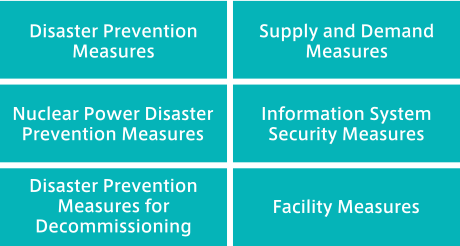
Under the Risk Management Committee, we have established six specialized subcommittees. Each subcommittee is chaired by an appointed responsible officer and conducts focused deliberations on issues and risks within its respective area of expertise.
Governance Framework
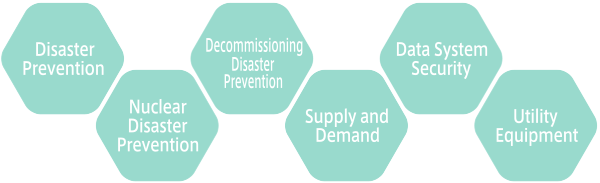
Six Specialized Subcommittees (Chairs: Each responsible officer)
Examples of Past Achievements
| Important Risks | Response |
|---|---|
| Stable Supply during the Tokyo Olympic and Paralympic Games | For the stable supply of electricity during the Tokyo Olympic and Paralympic Games (held July–September 2021), each subcommittee discussed and implemented measures, including operational arrangements during the Games and plans for drills simulating disasters, accidents, cyberattacks, and terrorism. These efforts successfully contributed to maintaining a stable electricity supply throughout the Games. |
Future Management Committee
In FY2022, the Carbon Neutral Challenge Task Force, a specialized subcommittee under the Future Management Committee, held 16 discussions on the functions and organizational structures required to achieve both long-term stable supply and carbon neutrality.
Achievements to Date (Carbon Neutral Challenge Task Force)
| Examples of Discussion Themes |
|
|---|---|
| Achievements | On April 28, 2022, we announced “Business Structure Reforms to Achieve Both Long-Term Stable Supply and Carbon Neutrality,” outlining a clear direction to focus on a new business model centered on locally-produced/locally-consumed equipment services, and to promote alliances and structural reforms to achieve this goal. |
| Future Initiatives | In addition to our existing electric power business, we will position locally-produced/locally-consumed businesses—such as solar power and storage batteries—along with equipment services and aggregation, as the pillars of our future operations. We will also examine the functions and organizational structures required for business expansion across the entire Group. |
ESG Committee
The ESG Committee deliberates on overall policies for addressing ESG issues, selecting key ESG items in management strategy, and establishing response policies related to information disclosure.
Most recently, the committee discussed ESG management strategies and climate change countermeasures based on the latest ESG trends.
Achievements to Date
| ESG Management Strategy |
Themes
|
|---|---|
Key Comments
|
|
| Climate Change Countermeasures |
Themes
|
Key Comments
|