














-
|
- Environment
- Social
- Corporate Governance
- ESG Library
Respect for Human Rights
Human Rights Due Diligence
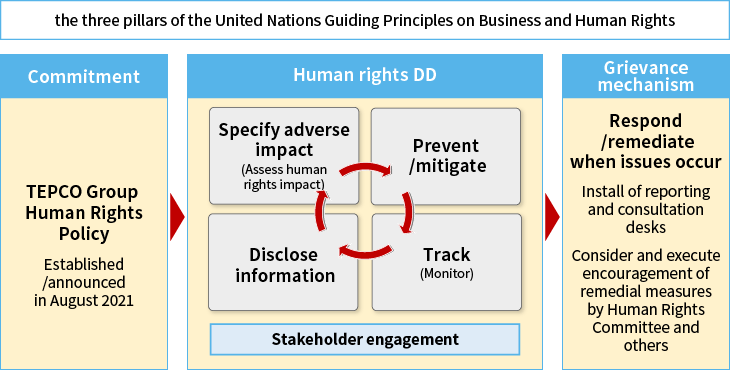
The TEPCO Group respects human rights in all aspects of its business activities. We built a human rights DD mechanism based on the United Nations Guiding Principles on Business and Human Rights so that the human rights of all stakeholders, including people impacted by our business activities, are respected. We also defined ”our companies,” “consolidated subsidiaries,” and “suppliers” as the scopes of our priority responses in this area.
The TEPCO Group’s system for respecting human rights
Scopes of priority response for human rights DD
Our group conducts human rights impact assessments and engagement activities based on the human rights issues outlined in our human rights policy, focusing on the following priority areas.
-
*
Our company: TEPCO Holdings and its Four core operating companies(TEPCO Fuel & Power, TEPCO Power Grid, TEPCO Energy Partner, and TEPCO Renewable Power.)
Human Rights Impact Assessments on Our Companies (Employees)
To implement human rights DD for our companies (employees), we specified adverse impacts caused by our business (human rights impact assessments). With the input from external experts, we analyzed our internal rules, results of employee opinion surveys, previous lawsuits, and contents of human rights grievances, among other information. We accordingly identified human rights issues and assessed them from the perspectives of the potential, scale, scope, and irremediability of human rights violations.
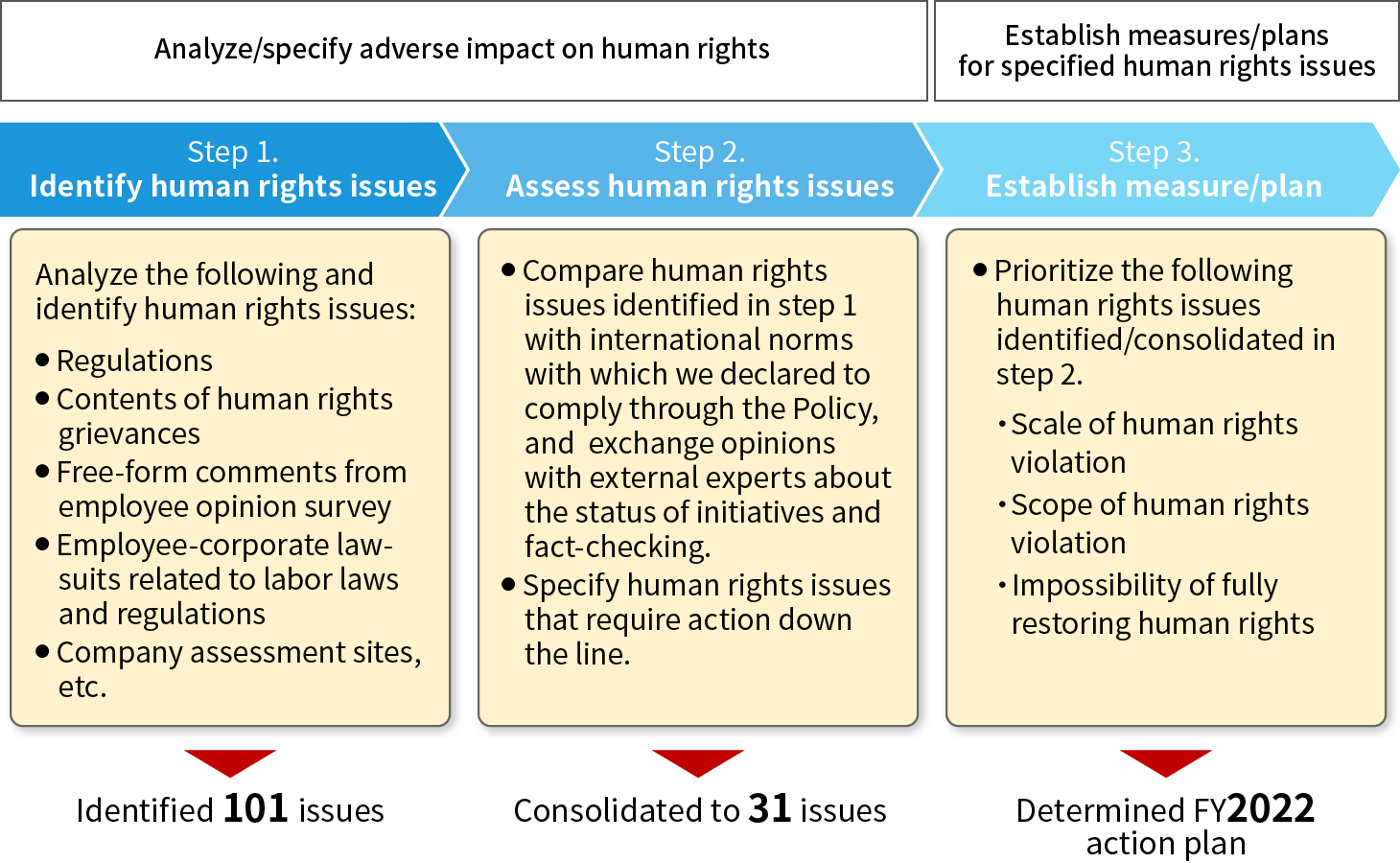
As a result, assessments showed particularly significant adverse impacts in the categories of harassment, working hours, and proper management of personal information. We have been addressing these three challenges for some time, and since FY2022 we have defined them as salient human rights issues and stepped up our efforts focused on preventing inappropriate cases related to them and minimizing impacts when such cases occur.
Human Rights Impact Assessments on Our Companies (Business)
Our company conducts human rights impact assessments through the following process.
-
(1)Conducting a Human Rights Self-Assessment
We carry out a self-assessment based on key human rights issues that companies are expected to consider, as outlined in international standards and guidelines (such as the UN Guiding Principles and OECD Guidance). -
(2)Interviews by External Experts
Based on the results of the self-assessment, external experts conduct interviews to identify items that each department considers to be potential human rights issues. - (3)We use findings from (1) and (2) to assess issues in terms of the potential, scale, scope, and irremediability of human rights violations, identify and prioritize critical human rights issues, and formulate an action plan.
Coverage Rate of Human Rights Impact Assessments to Date
In the fiscal year 2024, a Human Rights Self-Assessment was conducted across all headquarters departments of the TEPCO Holdings and core operating companies. The combined implementation rate for TEPCO Holdings and the core operating companies was 56.0%.
In FY2025, the assessment will be expanded to cover all departments of HD and the core operating companies, including frontline workplaces, with the goal of achieving a 100% implementation rate.
| HD | Conducted across all headquarters departments | 100% |
|---|---|---|
| PG | Distribution Department, Transmission Department, Real Estate Acquisition & Management Department, Electronic Telecommunications, Customer Service Department, Internal Audit Office, Policy Secretariat & Risk Management Office, Business Planning Office, Engineering Office, Innovation Promotion Office, Business Management Office, Human Resources Development Office, Procurement Office, Business Development Office, International Business Development Office, Cyber Security Center, Smart Meter Promotion Office, Power System Operation Department | 33.3% |
| RP | Hydro Power Department,Wind Power Department,Internal Audit Office,Business Planning Office,Innovation Promotion Office,Business Management Office,International Business Development Office | 45.9% |
| EP | Corporate Marketing and Sales Division, Customer Marketing and Sales Division, Carbon Neutral Marketing and Sales Department, Wholesale Electricity Marketing and Sales Office, Business Management Office, Internal Audit Office, Gas Business Department, Service Solutions Division, Business Transformation Division, Kaizen Promotion Office, Energy Procurement & Operation Department, Business Planning Office, Digital Transformation Promotion Office, Customer Experience Enhancement Office, Human Resources Strategy and Development Office | 59.5% |
Based on our efforts to date, we have confirmed that issues involving actual or potential adverse impacts on human rights, as well as those related to legal compliance, are being addressed appropriately.
In addition, for initiatives considered “desirable” under international standards such as the UN guiding principles, we are working with relevant departments to determine priorities and approaches for implementation.
Going forward, we will promote internal understanding of the “TEPCO Group Human Rights Policy” through expanded employee training and self-assessments. We will also strive to operate our business in a manner that respects the human rights not only of our own employees and organizations, but also of external stakeholders involved in our business activities.
Examples of Responses from Various Departments
-
○ Expansion of Power Plant Facilities with a Focus on Diversity
-
At hydroelectric power plants and dam facilities located in mountainous areas, it was identified that restroom facilities were inadequate for our female employees, causing them discomfort.
In response, a working group, led primarily by female employees, was formed to review and implement environmental improvements.
-
At hydroelectric power plants and dam facilities located in mountainous areas, it was identified that restroom facilities were inadequate for our female employees, causing them discomfort.
-
○ Measures to Support Foreign National Employees
- To ensure proper understanding of operational risks and enhance safety awareness, we created and distributed multilingual versions (English and Vietnamese) of the “Five Key Safety Principles”.
- Materials outlining safety precautions based on past incidents were made more visually accessible through the use of photos and illustrations. and translated into workers’ native languages to facilitate understanding.
- To improve the awareness of and trust in our consultation services at overseas offices, we provided information about these services in English. This helped to enhance the psychological safety for our employees at international locations.
-
○ Measures Against Risks in Procuring Solar Panels
-
We have formulated a policy for procuring electricity through solar power generation (excluding the FIT scheme), and are implementing measures in line with this policy.
This measure was taken to mitigate potential risks in solar panel procurement.
-
We have formulated a policy for procuring electricity through solar power generation (excluding the FIT scheme), and are implementing measures in line with this policy.
-
○ Response to Human Rights Risks Among Business Partners
- We have established a system to promptly share any emerging risks with subsidiaries that are closely connected to our business model. In addition, we actively communicate about these risks to ensure that the human rights of all individuals involved across the entire value chain are respected.
-
○ Initiatives to Strengthen Our Response to Human Rights Risks
- We have assigned risk managers within our organization to not only respond to manifest risks but also to detect potential risks at an early stage. A reporting system has been established to escalate such risks to the headquarters risk line through these managers.
- We have conducted a risk identification and assessment human right issues related to our overseas affiliates. We share the findings internally with relevant personnel and work to strengthen our response to these risks.
-
○ Proactive Acquisition of Risk Information from Business Partners
- We collect opinions and requests during regular discussions with our business partners, and strive to identify and understand potential risk information.
-
○ Overseas Initiatives to Promote Respect for Human Rights
- Even for overseas affiliates where our equity stake is limited, we actively promote respect for human rights through our assigned directors.
Initiatives at the Fukushima Daiichi Nuclear Power Station Pertaining to Respecting Human Rights (January 2024 update)
The decommissioning work underway at the Fukushima Daiichi Nuclear Power Station (“Fukushima Daiichi”) is supported by numerous contractors. Approximately 4,500 workers are engaged at the plant on any given week day (as of November 2023) and the TEPCO Group has been making, and will continue to make, significant efforts to improve the work environment at the Fukushima Daiichi.
Initiatives implemented to date.
-
(1) Initiatives to listen to the opinions of workers and make improvements
We have set up suggestion boxes and conduct questionnaires for all workers to voluntarily submit and communicate their opinions to TEPCO, and we provide feedback to workers on the status of response to their opinions.
-
(2) Relief mechanism for workers
We regularly inform all workers of the existence of a consultation desk for health management and working conditions, etc. through posting leaflets and the Occupational Health and Safety Promotion Council, of which the prime contractors are members.
-
(3) Compliance with laws and regulations, and reminding workers of these through prime contractors
TEPCO reminds workers of the importance of compliance with laws and regulations through addresses at the Occupational Health and Safety Promotion Council of which the prime contractors are members, legal compliance seminars held in cooperation with the Fukushima Labor Bureau, distribution of related pamphlets, and other activities.
-
(4) Efforts to eliminate occupational accidents by placing the highest priority on safety
Each time an accident occurs, TEPCO investigates the cause, formulates measures to prevent recurrence, thoroughly disseminates information on them, and ensures that they are reflected in the annual safety action plan in an appropriate manner.
-
(5) Appropriate radiation control based on laws and regulations
Radiation workers working in controlled areas are registered under the "Radiation Dose Registration Control System", and each time they enter such an area, they are fitted with personal dosimeters to measure their exposure doses and to ensure the accumulated doses for each individual will not exceed the regulatory limit.
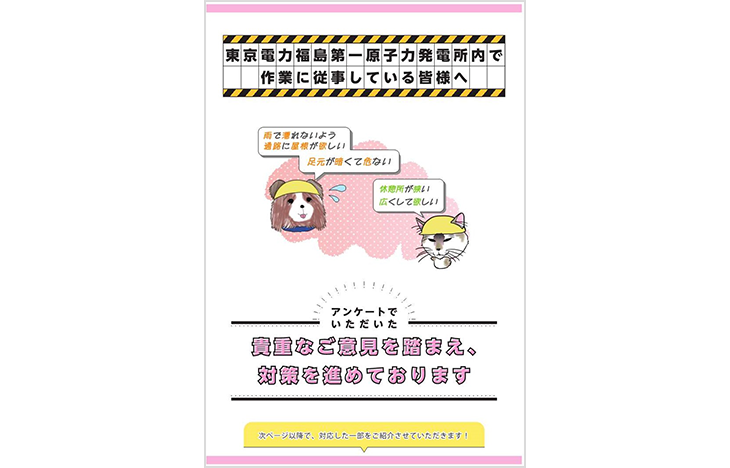
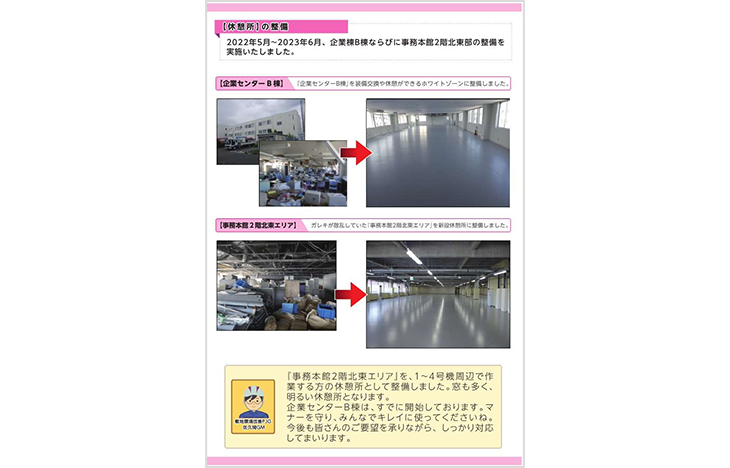
“To everyone working at the Fukushima Daiichi: We are implementing measures based upon your opinions conveyed through the questionnaire.”
In response to requests elicited through worker questionnaires, we have built a covered walkway, installed lighting, and established rest areas. The results of questionnaires are provided to workers as feedback.
In coordination with the Ministry of Health, Labor and Welfare’s Fukushima Labor Bureau, we have created a pamphlet on disclosing labor conditions and appropriate wage rules, etc., and have distributed it to workers.
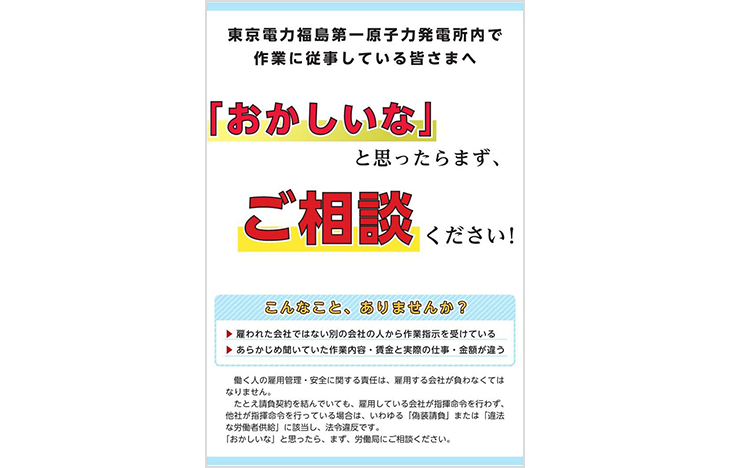
“To everyone working at the Fukushima Daiichi: If you notice anything out of place, please let us know!
In the area where workers wait for the site shuttlebus, we have posted a leaflet on the “Industrial Accident Compensation Insurance for Illnesses Caused by Radiation Exposure” to raise awareness.
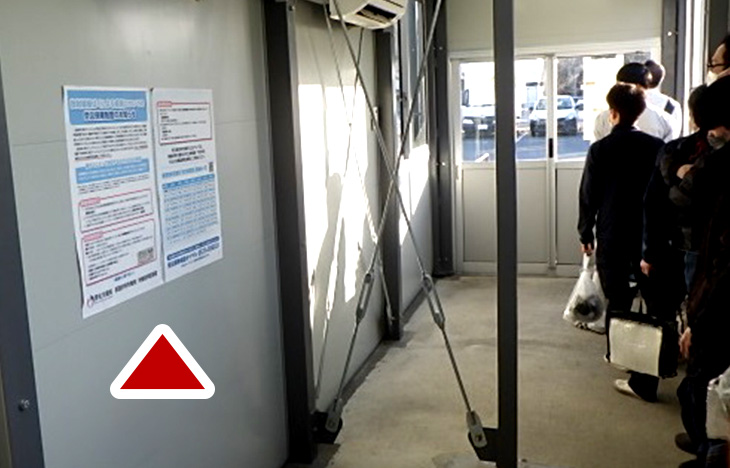
In order to complete the decommissioning of the Fukushima Daiichi, which is a key management issue, we are reviewing work processes from the perspective of respecting human rights and are deliberating/implementing enhancement measures in order to further protect human rights.
Three measures to enhance respect for human rights
-
(1) Enhancing cooperation with the prime contractors to ensure respect for workers' human rights (December 14)
Conducting human rights training, etc., at the Occupational Health and Safety Promotion Council etc.
-
(2) Enhancing the system to take on board workers' opinions
Constructing a system that makes it easier for workers to express their opinions in questionnaires, etc., while taking human rights into consideration.
-
(3) Enhancing the system to enable workers to engage in consultation without anxiety
Introducing methods of public notice that make it easier for workers to seek advice, such as the use of digital signage and considering reviewing leaflets, in a way that takes human rights into consideration
In conjunction with Human Rights Day (December 10), the Occupational Health and Safety Promotion Council held a meeting for approximately 60 prime contractors. The Fukushima Daiichi Nuclear Power Station Site Superintendent attended the session, during which the Human Rights Officer of TEPCO Holdings (“TEPCO HD”) explained the TEPCO Group Human Rights Policy and requested the contractors’ cooperation in promoting respect for human rights.(December 14, 2023)
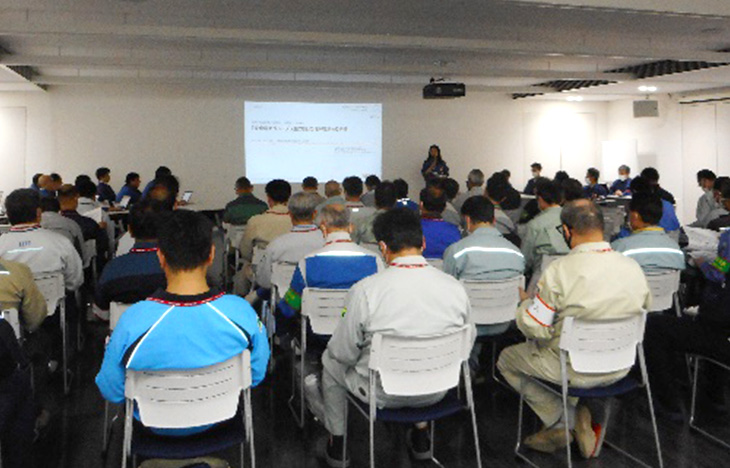
The TEPCO HD Human Rights Officer and the Work Environment Improvement Officer from TEPCO HD’s Fukushima Daiichi Decontamination and Decommissioning Engineering Company inspected the work environment to assess progress and identify areas for further improvement.
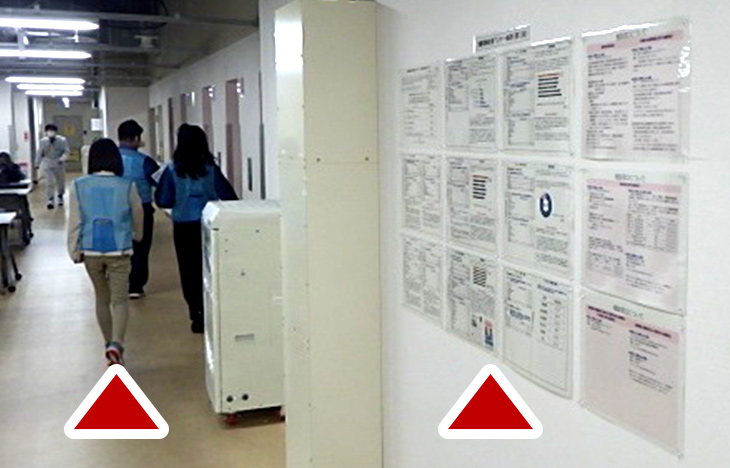
Results from the workers’ questionnaires have been posted on every floor of the large rest house, enabling workers to review them.
We have started to enhance the utilization of digital signage, enabling us to proactively display email addresses for the “Suggestion Box” and inform workers of the various consultation desks.
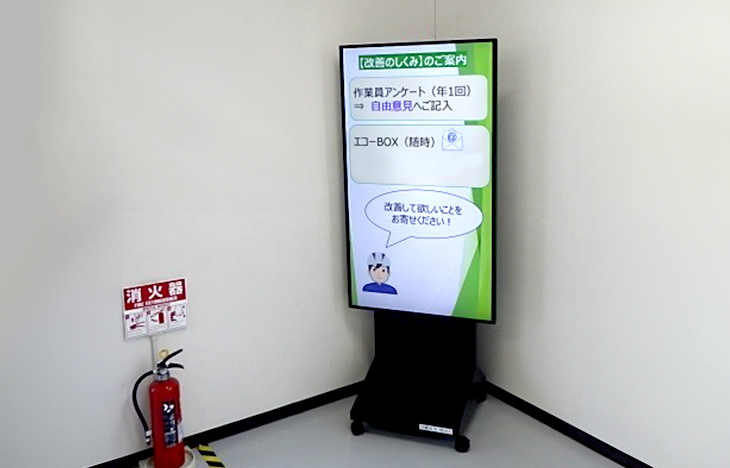
“Information about improvement triggers. Let us know areas for improvement.”
We have revised the leaflet that gives information on the various consultation desks.
< Prior to revision >
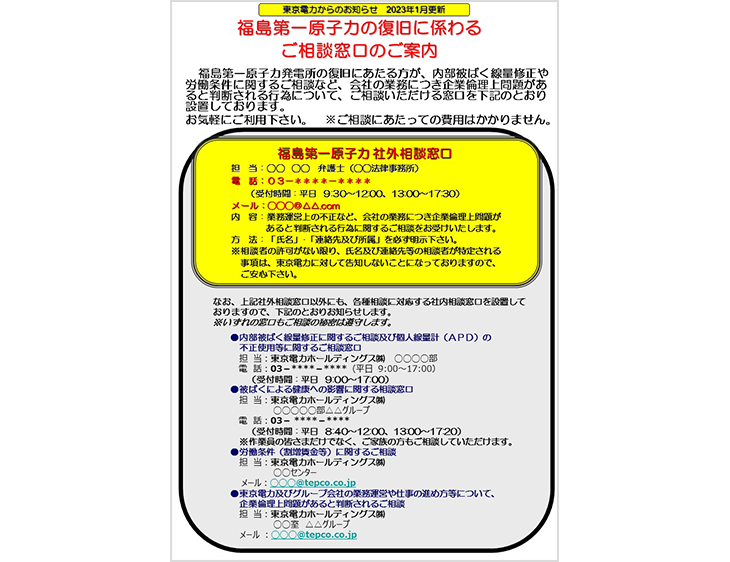
< After revision >
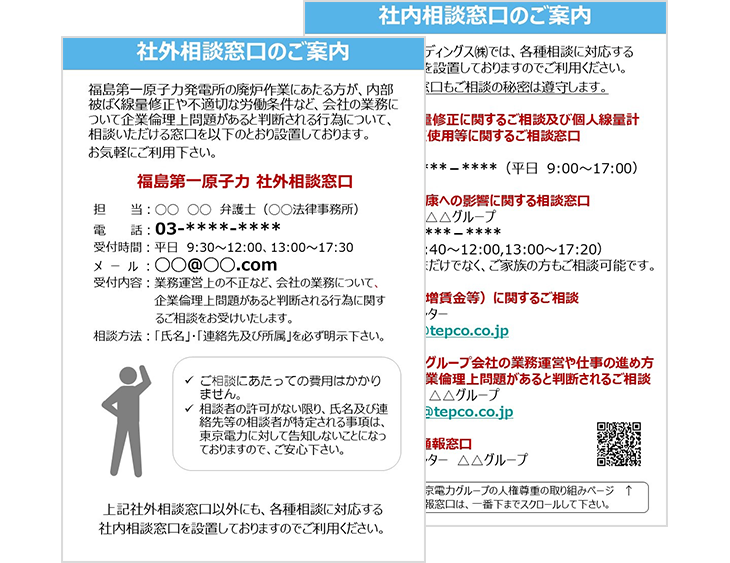
“We have established consultation desks both inside and outside the company for actions that have been deemed to infringe upon corporate ethics, such as internal exposure dose falsifications and unsuitable labor conditions, etc. Please feel free to use these services.”
- Free of charge
- Unless express permission is given by the con sulting party, no information, such as the name or contact information of the consulting party, will be disclosed to TEPCO, so please be assured that your information will be kept confidential.
(Issues pertaining to impact on health from exposure, such as internal exposure dose falsifications, etc., working conditions, corporate ethics, human rights, etc.)
- The font has been enlarged to make it easier for the elderly to see, and the pamphlet has been colored blue to bring about a feeling of ease and accommodate people with color vision variation.
- The “Consultation Desk for Notification of Issues Pertaining to Human Rights” has been added along with a QR code to make information easy to access.
Human Rights Impact Assessments on Consolidated Subsidiaries
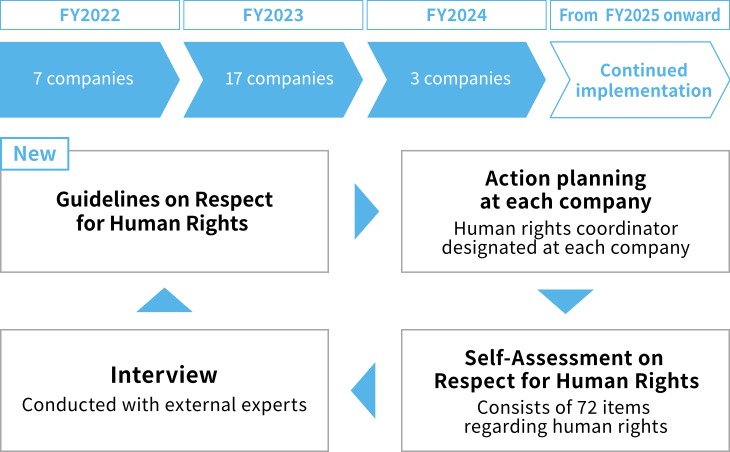
- Following the previous year (FY2021), in FY2022 we conducted a “Human Rights Respect Self-Assessment” targeting 38 major consolidated subsidiaries that fall within the scope of "TEPCO Group Human Rights Policy" and are also suppliers and business partners of TEPCO Holdings and its core operating companies. The assessment covered 72 items, including internal systems for respecting human rights, human rights initiatives related to suppliers, and the status and responses to the nine human rights issues committed to in our Human Rights Policy.
-
Taking into account the unique characteristics of each consolidated subsidiary based on factors such as company size, year of establishment, and business nature, it is necessary to identify each subsidiary's challenges and formulate and implement appropriate measures. For this reason, we have been conducting individual interviews with priority assigned to each subsidiary since the fiscal year 2022.
In FY2022, interviews were conducted with 7 companies, in FY2023 with 17 companies, and in FY2024 with 3 companies, completing a full cycle of major consolidated subsidiaries over three years. - In FY2023, each subsidiary appointed a “human rights officer” to enhance collaboration with TEPCO Holdings , and we developed the “TEPCO Group Human Rights Policy Implementation Guidelines” to promote autonomous human rights initiatives within each subsidiary.
- In FY2024, based on the guidelines, each subsidiary formulated its own human rights action plan, and HD began monitoring these efforts. Additionally, an English version of the guidelines was created for overseas subsidiaries.
System for Promoting Respect for Human Rights at Consolidated Subsidiaries
Reference
Human Rights Impact Assessments on Suppliers
We established the Sustainable Procurement Guidelines (the “Guidelines) in May 2021 by adding an element of respect for human rights to the Basic Policy on Procurement, with the aim to develop stronger respect for human rights in our supply chain. We also developed a system to reinforce our suppliers’ respect for human rights and started to take action in FY2022. Example endeavors include having suppliers submit a confirmation document that declares they are properly practicing the Guidelines, and distributing a Sustainable Procurement Questionnaire to check the extent to which suppliers are complying with the Guidelines.
System to Reinforce Suppliers’ Respect for Human Rights
- We apply the PDCA cycle to develop stronger respect for human rights in the supply chain.
- The PDCA cycle is run as a three-year cycle.
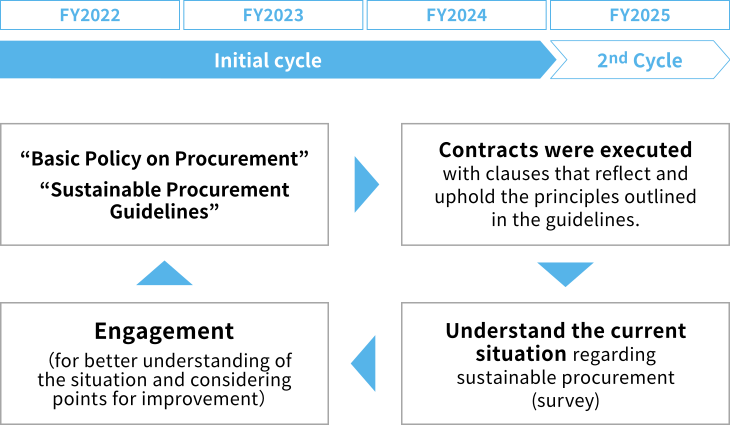
Provisions related to human rights compliance were added to contractual agreements.
We have previously obtained confirmation letters from suppliers as proof of their commitment to uphold the spirit of the "TEPCO Group Sustainable Procurement Guidelines"
Starting in FY2024, we have strengthened contractual obligations by incorporating human rights compliance provisions directly into our contracts. Specifically, these provisions stipulate that contractors must comply with the UN Guiding Principles and conduct human rights due diligence (DD) within their contractual supply chains under their own responsibility.
Furthermore, in cases where human rights due diligence reveals adverse human rights impacts, or if human rights violations are identified in the contractor’s business activities, the contractor is required to promptly report to the client, formulate a corrective action plan, and implement it. These requirements are clearly stated in the contract clauses and agreed upon with suppliers at the time of contract execution.
Results of Sustainable Procurement Survey
In FY2022, we asked approximately 300 suppliers to complete a roughly 60-item Sustainable Procurement Survey on seven areas—human rights, CSR, compliance, occupational health & safety, the environment, risk management, and sustainable growth across the entire supply chain—and on their contributions to local communities. The results indicated that the larger the company is, the more likely it is to have a balanced commitment across the board for all areas.
■ Feedback to survey respondents
In FY2022, we received responses from approximately 300 companies to around 60 questions covering human rights, CSR, compliance, occupational health and safety, environmental issues, risk management, and contributions to sustainable development and local communities across the entire supply chain.
In FY2023 and FY2024, the number of responding companies increased to approximately 650 each year.
Overall, the results revealed that the larger the company, the more consistently it engages with all of these areas.
Feedback resources
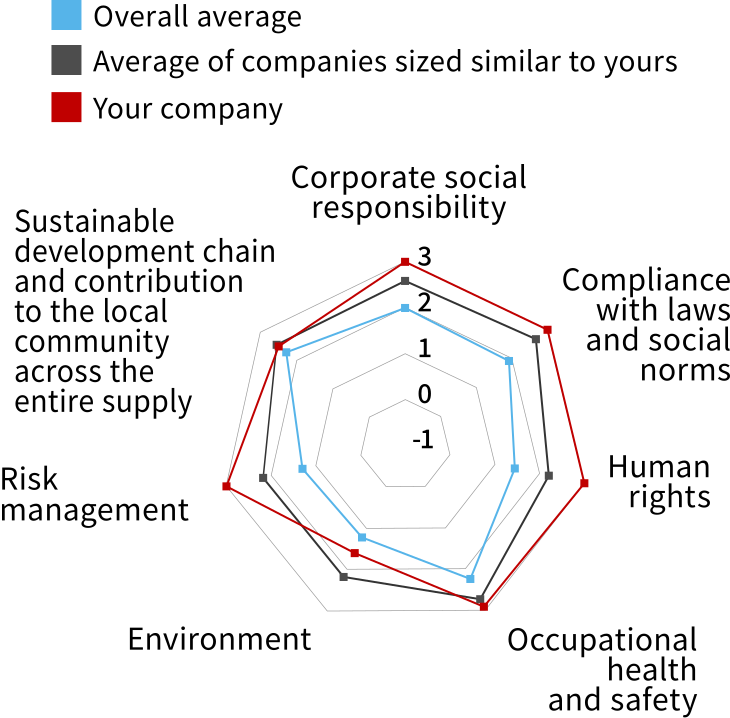
Benchmarked radar graph
Three values shown:
- Overall average
- Average of companies sized similar to yours
- Your company
Example of a feedback radar chart
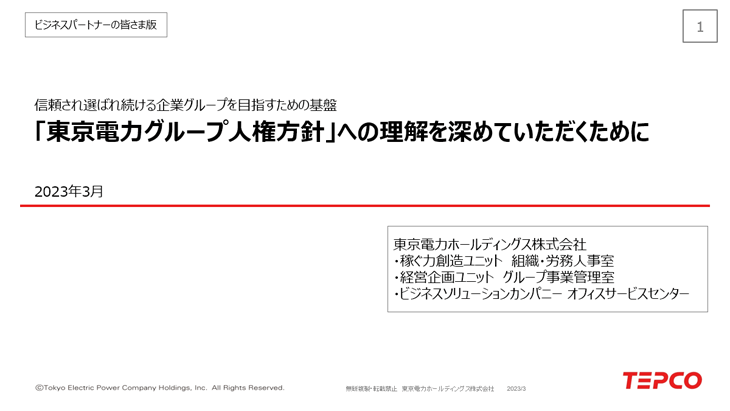
Human rights training material
Of the seven areas covered by the survey, it was found that there was room for improvement in measures for the area of human rights. In response, a material for use in human rights training was provided to the suppliers along with the survey feedback.
The material also contains information on the Human Rights Reporting Desk, which offers service to all stakeholders, including suppliers.
■ Dialogue Implementation
The scoping of human rights due diligence (DD) for suppliers was conducted based on the OECD Due Diligence Guidance for Responsible Business Conduct, considering three key perspectives: sector/business characteristics, products, and geographical factors.
In addition, tools such as the UNEP FI Human Rights Guidance Tool and FTSE Risk Exposure were utilized and analyzed. As a result, in FY2022, the construction sector was concluded to be of high priority.
| Issues | Occupational health & safety, worker exploitation through subcontractor chains, foreign worker issues, etc. |
|---|
In FY2022 we engaged with six suppliers based on the results of the Sustainable Procurement Survey.
Through this we learned that smaller enterprises in particular tend to be behind the curve in how they commit resources to this area.
In FY2023, we engaged with three suppliers handling batteries, focusing on the issues of “responsible mineral sourcing,” “child labor,” and “forced labor.”
In FY2024, we conducted engagement with four suppliers, addressing key issues such as “human rights,” “environment,” and “risk management.”
Going forward, we will continue implementing the initiatives below to highlight the necessity of human rights DD in our supply chain, and provide guidance and assistance where needed.
| Our initiatives | Expected outcomes |
|---|---|
| Company-specific feedback on the Sustainable Procurement Survey results | Objective recognition of own company's strengths and weaknesses |
| Distribution of human rights training material (information on the policies and the Reporting Desk) | Promotion of understanding of the TEPCO group's commitment to respecting human rights |
| Continuous engagement | Enhancement of communication with suppliers, identification of potential risks within our supply chain, and promotion for implementation of human rights due diligence |
Basic Policy on Procurement
| Basic Policy on Procurement |
|
|---|